Codex / the brains app store

An app store for agentic work.

Install boards, automations, and integrations in one click, or build, version, and publish your own. Packaging, dependencies, and upgrades work like the tools developers already trust.

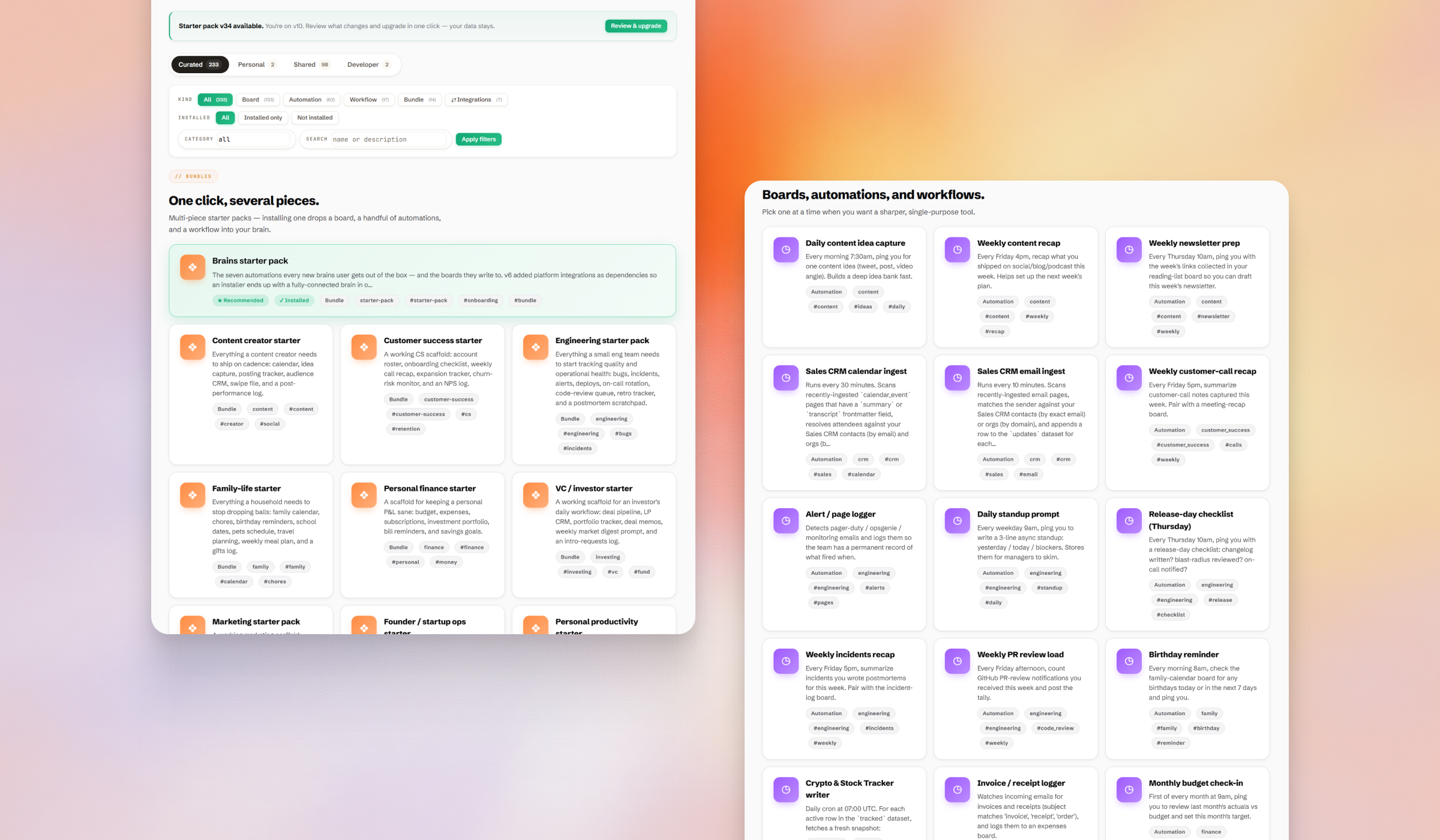
Codex app store showing recipe filters, starter packs, and automation cards

Use what others already built.

Each recipe is one packaged unit of capability, installed from the web, CLI, or MCP.

hiring-pipeline

Candidate board, fit scoring, and public application form.

BundleInstall

deal-tracker

CRM board with enrichment and a weekly leadership digest.

BundleInstall

morning-brief

A daily read from your inbox, calendar, and open boards.

AutomationInstall

github-issues

Sync issues, pull requests, and reviews into a typed board.

IntegrationInstall
$ brains install "hiring-pipeline"
resolved 3 dependencies / scoped to brain / ready in 2s
Catalog

Four recipe kinds. One source of truth.

A recipe can be a board, automation, integration, or a bundle combining all three. The catalog is identical across web, CLI, and MCP, searchable by category, popularity, and author.

Image placeholder - recipe catalog preview
  • BoardA typed dataset with a working interface.
  • AutomationA sandboxed, cost-capped program.
  • IntegrationA scoped connector to an external tool.
  • BundleA recipe of recipes installed atomically in one transaction.
Dependencies

One install. Whole tree.

Recipes declare dependencies, integrations, and scopes. Codex resolves the tree in topological order and treats the bundle as the canonical upgrade unit, so children never drift from their parent.

Semver aware

Pin a version, use a caret, or provide a range. Codex selects the highest valid release.

Atomic

Either the whole recipe tree installs or upgrades, or none of it does.

Reversible

Every install and upgrade is audited and can return to the prior version.

starter-pack v7 -> v8
gmail-inbox v1.8.0 -> v1.9.0
gcalendar v1.4.2 -> v1.5.0
gdrive-files v1.3.1 -> v1.4.0
github-issues v2.0.0 -> v2.1.0
monday-items + new
Publish

Write a recipe. Ship it.

Author in TypeScript, review against the local sandbox, then publish to your team's private registry, your organization, or the public catalog. Every publish is a version and every subscriber gets an explicit upgrade path.

  • AuthorWrite recipe code, declare the manifest, and provide the inputs a teammate needs to install it safely.
  • ReviewRun static checks, a sandbox test, and a scoped diff against the prior version before anything ships.
  • PublishTag the release, push to a private or public registry, and give subscribers an explicit upgrade path.
Manifest

The manifest is the contract.

Declare kind, dependencies, typed inputs, triggers, integrations, and scopes. Anything not declared cannot run, and reviewers can see the complete safety shape in one place.

{
"name": "renewal-radar",
"kind": "bundle",
"dependencies": ["deal-board", "gmail-inbox"],
"scopes": ["brain:read", "boards:write"],
"triggers": [{ "memory": "email" }]
}

A recipe's manifest.json declares everything Codex needs to install it safely: which integrations it talks to, which scopes it needs, what inputs the installer must provide, and what triggers it subscribes to. Anything not declared cannot run, so reviewers can audit the full safety and runtime shape before anything is published or installed.

  • Typed inputsCodex prompts the installer for anything missing, from API credentials to workspace-specific configuration.
  • Declared scopesEvery integration call, board write, and memory read is visible in the manifest before install.
  • Sandbox by defaultRecipes cannot touch network, filesystem, or environment state unless those capabilities are explicitly declared.
  • Static + dynamic checksPre-publish linting and sandbox runs catch regressions, bad assumptions, and scope drift before release.
  • Private or publicShip to a teammate, your organization, or the public catalog using the same contract and upgrade model.
Versions

Every change is a version.

Each publish carries a semantic version, required changelog, and exact diff. Installs are pinned by default, upgrades are explicit, and rollback takes one command without losing data.

Recipes cannot escape

Runtime scopes are enforced at the worker boundary.

Recipes compose

An automation can depend on boards, integrations, and other automations.

Share at any level

Private, team, organization, or public use the same package and upgrade model.

Install what works. Build what is missing.

Join waitlist